

CO2Rail is building specially designed rail cars equipped with innovative technology that harnesses regenerative braking energy—an otherwise wasted resource in most trains—to enable both cost-effective diesel locomotive decarbonization through Carbon Capture and Storage (CCS) and commercially viable Direct Air Capture (DAC) for ambient air Carbon Dioxide Removal (CDR).

By leveraging the vast global rail network, extensive infrastructure, and a well-established manufacturing base, CO2Rail drives scalable and efficient climate solutions. A solution that can achieve over One Gigaton of CO2 removal just with the regenerative braking energy currently being produced then immediately wasted in most trains.
CO2Rail's Direct Air Capture (DAC) system can sit in any configuration on a train and uses energy from a regenerative braking system to capture carbon from ambient air.

CO2Rail's proprietary LETA (Locomotive Exhaust Transfer Array) emissions mitigation system can effectively capture up to 70% of a diesel locomotive’s exhaust.

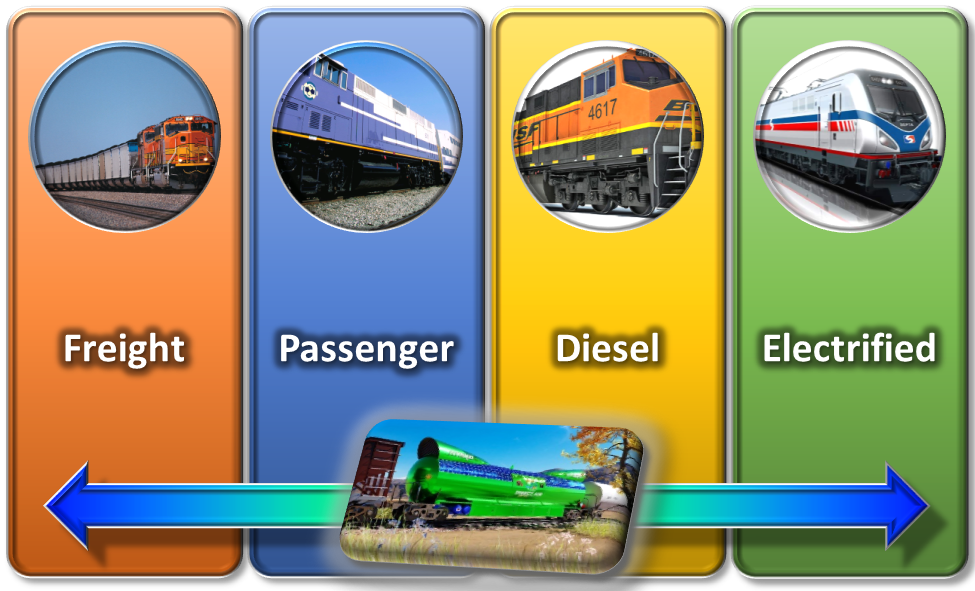


If as many CO2Rail cars were built as the global rail networks could easily power in currently produced (but wasted) regenerative braking energy, today's CO2 removals could exceed one billion tonnes per year. As DAC efficiencies improve and global rail utilization increases, CO2Rail's long-term potential could reach 50%–60% of the IPCC's recommended CDR target of 10 GT/year."

CO2Rail requires only minor adjustments to a railroad's operations and a locomotive's current electrical system—making it an effective short-term decarbonization method that operates on existing infrastructure. If laid end to end, this infrastructure would stretch to the Moon almost four times, with railcars and locomotives that would circle the equator three times.

CO2Rail uses the enormous amount of electrical energy generated from stopping or slowing an entire heavy, fast moving train many times per day to power CO2 removal from both ambient air and emissions from diesel-powered trains. Energy that currently goes to waste in most trains.

Compared to alternative uses of a train's enormous regenerative braking energy, such as additive propulsion or HEP utilization, CO2Rail is over 5 times better at carbon mitigation per unit of energy recovered.

Compared to alternative large-scale direct air capture methods, CO2Rail has practically no fixed land-based footprint. Other DAC methods could require a footprint as large as the entire country of Portugal to achieve the IPCC's recommended CDR target of 10 GT/year CO₂e.

CO2Rail's system is sorbent-agnostic and provides a versatile platform for a suite of DAC and CCS technologies, both existing and anticipated. Whether electro, temperature, pressure, humidity, or other types of sorbents—both solid and some types of liquid—the CO2Rail platform can deploy at scale and remain easily upgradable.

Rail operators can scale our solution as far and wide as they need – taking on additional railcars as needed to decarbonize their operations and maximizing DAC CDR removals according to their specific regenerative braking energy generation projections.

All CDR methods are not equal. Direct air capture represents the highest quality CDR method available thereby increasing the monetary value of both CO2Rail's product ultimately sequestered and its off-take agreements.

By tapping into the currently wasted regenerative braking energy generated from trains already moving freight and passengers, CO2Rail is able to significantly lower the cost of DAC, with high-confidence projections ultimately aiming for a cost of less than $50/tonne CO₂e.

With the lowest per-unit CAPEX investment requirement compared to other solutions, most required deployment infrastructure already having been built, and the highest potential margins, CO2Rail projects mid-term ROI measured in dozens of months, not dozens of years.




.jpg)


Understand the proprietary technology behind CO2Rail's direct air carbon capture via this peer-reviewed research paper.
